AI Detector AI detection scores can feel intimidating. A student uploads an essay, waits for a report, and suddenly sees a number from 0 to 100 attached to the question of authorship. A teacher sees the same number and has to decide whether it is a small warning sign, a serious concern, or simply a feature of formal academic writing. The problem is that the number looks precise, but it is not a final judgment.
This guide explains what AI Detector AI detection scores mean, how to read the 0 to 100 scale, why false positives can happen, and how students can use tools such as Quilbot, Quilbot-style AI detection, and Quilbot Humanizer responsibly. The goal is not to "beat AI Detector." The goal is to understand the report, improve your writing process, and make sure the final paper reflects your own ideas, sources, and voice.
What a AI Detector AI Score Actually Measures
A AI Detector AI score is an estimate of how much submitted prose appears to match patterns often found in AI-generated writing. It is different from the classic AI Detector similarity score. Similarity compares text against databases, websites, publications, and other student papers. AI detection looks at language patterns: sentence rhythm, predictability, phrase choice, paragraph structure, and the way ideas unfold.
That distinction matters. A paper can have a low similarity score and a high AI score. It can also have a high similarity score and a low AI score. Plagiarism and AI authorship are related academic integrity topics, but they are not the same thing.
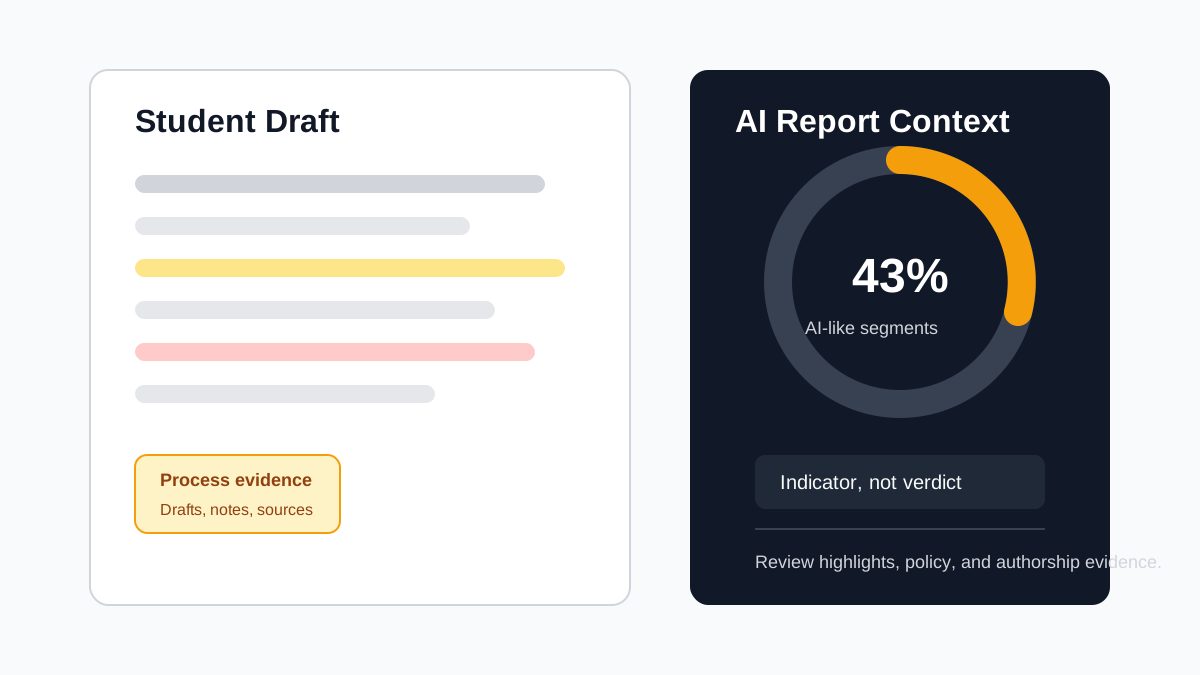
AI Detector's AI percentage should be treated as a signal. It may suggest that a section deserves closer review, but it does not prove misconduct by itself. Good academic decisions require context: the assignment prompt, course AI policy, drafts, notes, citation quality, version history, and the student's ability to explain the argument.
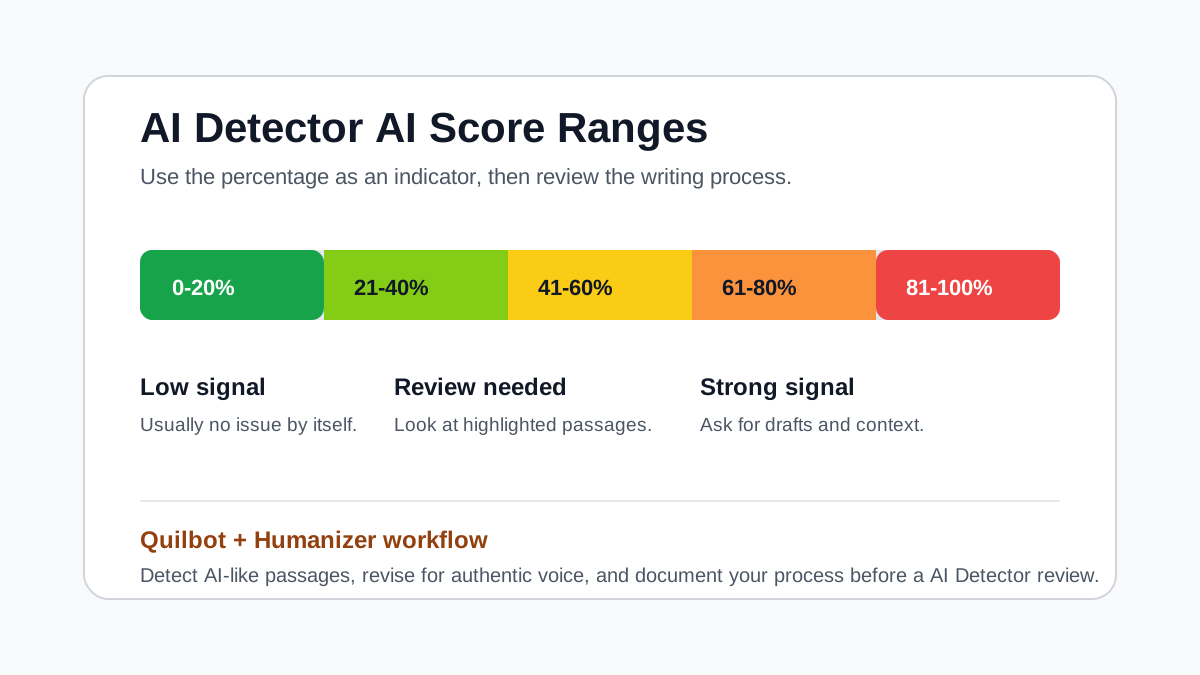
The 0 to 100 Breakdown
No single score range works perfectly for every school, discipline, or assignment. Still, students and educators need a practical way to interpret the number. Use the ranges below as guideposts, not rules.
0%: No AI-Like Writing Detected
A 0% score usually means AI Detector did not identify segments that strongly resemble AI-generated prose. This is a good sign, but it does not guarantee that no AI tool was used at any stage. A student may have brainstormed with AI, heavily revised a draft, or used grammar support in ways that leave little detectable pattern.
For students, a 0% score is not a reason to ignore documentation. Keep outlines, notes, source annotations, and drafts anyway. If a question ever comes up, process evidence is more useful than the score alone.
1-10%: Minimal AI-Like Signals
A score between 1% and 10% often points to small sections of formulaic phrasing. Common examples include generic transitions, highly standardized definitions, or short sentences that resemble common AI outputs. In many academic settings, this range is not treated as a serious concern by itself.
Students should still review the highlighted areas if they are available. If the same phrases appear repeatedly, rewrite them in your own voice. Quilbot Humanizer can help identify robotic phrasing, but you should review every suggestion manually and make sure the sentence still matches your meaning.
11-20%: Noticeable AI-Like Content
At 11% to 20%, the report is more noticeable. This does not automatically mean misconduct, but it may justify a closer look. Sometimes the issue is a paragraph that reads like a generic overview. Sometimes it is a methods section, lab summary, or policy explanation that uses very standard language.
If you are a student, be ready to explain your process. Show your notes, outline, source list, and revisions. If AI use was allowed, disclose how you used it. If you used Quilbot, Quilbot, or another Humanizer for sentence-level editing, make clear that you reviewed and owned the final text.
21-40%: Significant AI-Like Sections
A AI Detector score in the 21% to 40% range usually means a meaningful portion of the paper resembles AI-generated writing. It may happen when a student starts with an AI draft and revises only lightly. It can also happen in assignments with very rigid structures, especially if the writing lacks personal analysis or discipline-specific detail.
This is the range where process evidence becomes essential. Students should gather earlier drafts, document timestamps, comments, research notes, and any feedback from the instructor or writing center. Educators should review the highlighted passages instead of relying only on the overall percentage.
41-60%: A Large Share Reads as AI-Like
Scores between 41% and 60% suggest that a large share of the submission has machine-like patterns. The writing may be polished, balanced, and grammatically correct, yet oddly generic. It may use broad claims without concrete examples. It may sound like it is summarizing a topic from a distance rather than developing the student's own argument.
Students should not panic, but they should take the score seriously. If the paper is genuinely yours, prepare evidence. If you used AI in a way that went beyond the course policy, be honest and ask what options are available. If the problem is style, a careful revision with Quilbot Humanizer can help you see where the paper sounds too uniform, but the deeper fix is to add your own reasoning, source engagement, and specific examples.
61-80%: Predominantly AI-Like Writing
A 61% to 80% score is a strong signal that most of the text resembles AI output. False positives are still possible, especially with formulaic genres, but the burden of explanation becomes heavier. A student may need to show multiple drafts, notes, source annotations, and a clear account of how the paper developed.
For educators, this range should trigger a careful review rather than an instant penalty. Check whether the student had clear policy guidance. Compare the work to earlier writing samples. Ask the student to explain key claims, source choices, and revision decisions. The issue is not only whether AI was used, but whether the final submission represents the student's learning.
81-100%: Highly AI-Like Text
Scores from 81% to 100% indicate that the submission strongly resembles AI-generated prose throughout. This is the most serious range, but it still requires due process. A high AI Detector AI score is not the same as a confession, and institutions should follow their academic integrity procedures.
Students facing this range should collect everything related to authorship: document version history, browser research notes, handwritten planning, citation drafts, email feedback, and outlines. If AI was used outside the rules, honesty usually leads to a better outcome than denial. If the score is wrong, evidence is the strongest response.
Why AI Detector AI Scores Can Be Misread
AI detection is probabilistic. That means it estimates likelihood based on patterns; it does not know who wrote the paper. Several normal writing situations can raise an AI score without proving misconduct.
Highly formulaic assignments are one example. Lab reports, abstracts, legal summaries, business memos, and policy briefs often use predictable structure. Students may also use templates provided by instructors. When many writers follow the same pattern, the prose can look less individual.
English learners can face another challenge. Clear, simple, grammatically regular sentences may sometimes look machine-like because they avoid idiom, interruption, and irregular rhythm. That does not make the writing dishonest.
Over-polishing can also cause problems. A paper that has been aggressively cleaned by grammar tools may lose the texture of human drafting. Every sentence becomes smooth, balanced, and safe. Quilbot Humanizer is useful here because it highlights overly robotic sections, but students should use it to restore natural voice, not erase all individuality.
AI Detector Score vs Similarity Score
Many students confuse AI detection with plagiarism detection. A similarity score asks, "How much of this text overlaps with known sources?" An AI score asks, "How much of this text resembles AI-generated writing patterns?" They answer different questions.
For example, a student could write a fully original but generic essay about climate change. It might have low similarity because it does not copy sources, yet it could have a moderate AI score if the language sounds predictable. Another student could paste a paragraph from a website. That may raise similarity even if the paragraph was written by a human.
Responsible writing requires attention to both. Cite sources carefully, paraphrase accurately, and make sure the structure of the argument is your own. Quilbot can help with readability and AI-like phrasing, but no tool can replace source verification and original thinking.
How Quilbot and Humanizer Fit Into the Process
Quilbot is useful because a score alone does not tell you what to fix. A student may see "36%" and wonder whether the problem is the introduction, the conclusion, a definition, or the whole paper. Quilbot's AI Detector and Humanizer workflow focuses on sentence-level review.
The detector can help you find passages that sound AI-generated. The Humanizer can then suggest more natural wording, varied sentence structure, and less formulaic transitions. This is especially helpful for AI-assisted drafts that contain phrases such as "it is important to note," "in today's fast-paced world," "this essay will explore," or "in conclusion, it is clear that."
But there is an important limit. A Humanizer should not be used to disguise work that you do not understand or did not create. The best use of Quilbot Humanizer is revision: keeping your meaning, improving clarity, and making the prose sound more like a real person with a real argument.
A Responsible Revision Workflow Before AI Detector
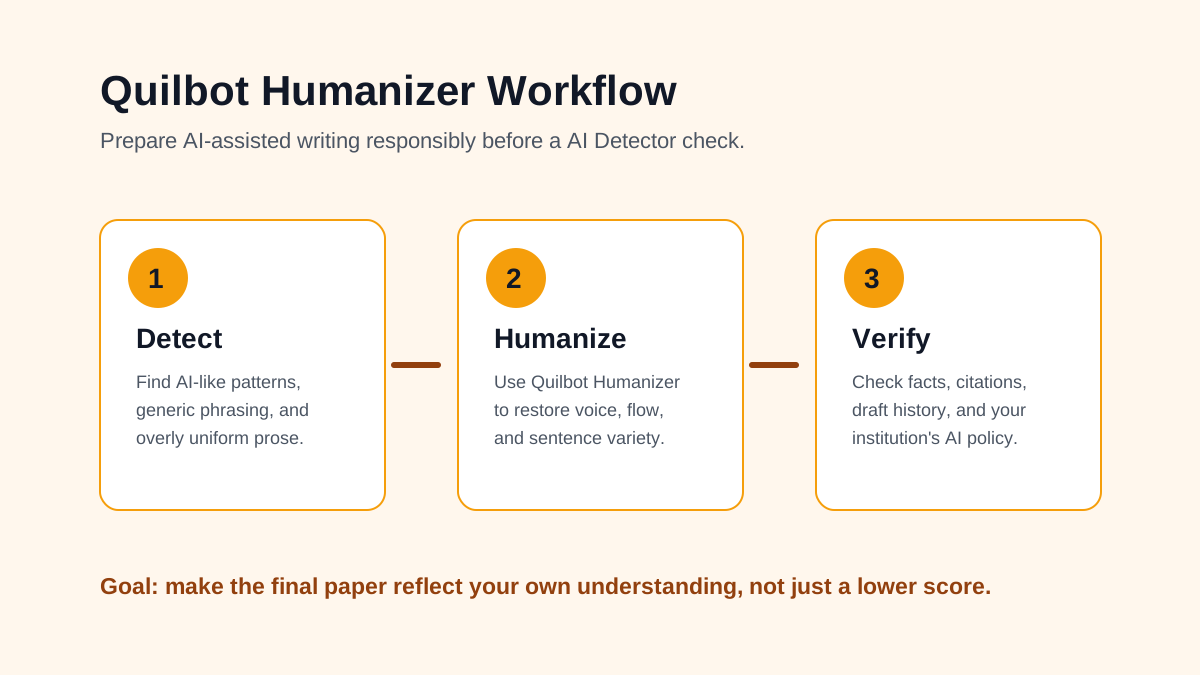
Start with your own outline. Before using any tool, write the thesis, key points, and evidence in your own words. This gives you a record of your thinking and helps prevent the paper from becoming a generic AI summary.
Next, draft with sources open. Add citations as you write, not after. If you use AI for brainstorming, keep a note that explains what you asked and how you used the output. Some schools require disclosure, and even when they do not, private notes help you remember your process.
Then run an AI-style review. Use Quilbot or another detector to identify passages that sound too predictable. Read the flagged sentences carefully. Ask: Is this my actual point? Is it specific enough? Does it connect to my evidence? Would I say it this way in a conference with my instructor?
After that, use the Humanizer selectively. Accepting every rewrite can flatten your paper in a different way. The better approach is to compare suggestions, borrow useful phrasing, and revise in your own style. Add concrete examples, course concepts, and source-based analysis. AI Detector is more likely to flag generic prose than writing that shows a clear human trail of decisions.
Finally, preserve your evidence. Save drafts, keep comments, and avoid copying everything into a blank document at the end. Version history is one of the strongest ways to demonstrate authorship.
What Students Should Do After a High Score
If you receive a high AI Detector AI score, do not respond emotionally or delete your files. Gather evidence first. Find drafts, notes, source PDFs, outlines, screenshots of version history, and any feedback you received while writing.
Read the flagged passages if your report shows them. Are they definitions? Transitions? Summary paragraphs? Conclusions? A high score concentrated in generic background sections is different from a high score across the central analysis.
Prepare a calm explanation of your process. You do not need to attack the tool. Instead, explain how you chose the topic, what sources you used, how the thesis changed, and what revisions you made. If you used Quilbot, Quilbot, ChatGPT, grammar software, or a Humanizer, describe the use honestly according to your course policy.
If you did misuse AI, the best next step is still transparency. Many institutions treat honest cooperation differently from denial. Ask whether revision, a process reflection, or a learning-focused remedy is possible.
What Educators Should Do With a Score
Educators should treat the AI Detector AI percentage as a starting point for review. The number can help identify papers that deserve closer attention, but it should not replace professional judgment.
Good review starts with the assignment policy. Were students told whether AI tools were allowed? Were examples provided? Did the assignment require process work, drafts, or reflections? A policy that says "no AI" is less useful than one that defines brainstorming, outlining, grammar support, paraphrasing, citation help, and prohibited drafting.
Next, read the highlighted sections. A paper with generic introduction and conclusion flags may require different handling than a paper whose entire argument appears machine-generated. Compare with prior writing samples where appropriate. Ask questions that invite explanation rather than accusation.
Finally, document the review. Note the score, the highlighted areas, the student's response, and the evidence considered. This protects fairness and helps students understand that academic integrity is about learning, not only punishment.
FAQ About AI Detector AI Scores, Quilbot, and Humanizer Tools
Does 0% mean no AI was used?
No. A 0% score means the detector did not find strong AI-like patterns. It does not prove that no AI tool was used during brainstorming, outlining, editing, or revision.
Can AI Detector be wrong?
Yes. AI detectors can produce false positives and false negatives. Formulaic writing, over-polished prose, short assignments, and standardized academic language can complicate the result.
Can Quilbot guarantee a lower AI Detector score?
No tool can guarantee a AI Detector result. Quilbot Humanizer can help you identify and revise AI-like wording, but detection systems change and every paper is different.
Is using a Humanizer allowed?
It depends on your school and instructor. Some courses allow editing and grammar support; others restrict AI rewriting. Always check the policy and disclose tool use when required.
What is the safest way to use Quilbot before submission?
Use Quilbot as a revision assistant. Keep your own thesis, sources, analysis, and drafts. Review every Humanizer suggestion manually, verify citations, and make sure the final essay reflects your understanding.
Bottom Line
AI Detector AI detection scores are useful, but they are not verdicts. A low score does not prove perfect originality, and a high score does not automatically prove misconduct. The number should lead to better review, clearer writing policies, and stronger evidence of the writing process.
For students, the best strategy is simple: write from your own understanding, keep drafts, cite sources, and revise carefully. For educators, the best strategy is to combine the AI indicator with context, process evidence, and fair conversation. Quilbot, Quilbot-style detection, and Quilbot Humanizer can support that process when used responsibly. They work best when the goal is authentic writing, not hiding authorship.